Siegel Family Endowment

We aim to understand and shape the impact of technology on society.


Explore
What we do

We deploy an inquiry-based model of philanthropy, funding initiatives, research, and communities tackling society’s most urgent challenges at the intersections of learning, work, and infrastructure.

Technological change has radically altered the way we live, work, and learn. The transformation of the global economy has impacted society on every level—from schools to the workplace to our communities—and altered the terms on which people are able to access opportunities and thrive in daily life. In order to address the biggest challenges we face today, we aim to support technology that serves the public interest, and ensure all people can engage with and affect change in a rapidly evolving world.
Siegel Family Endowment logo

Who We Are

Founded in 2011 by David Siegel, co-founder and co-chairman of the financial sciences company Two Sigma, we believe that philanthropy is society’s risk capital–it can help drive innovation by investing in local leaders and community-born solutions, fostering prosperous and equitable futures for all. Our work is centered around funding organizations that address society’s most critical challenges, while supporting innovative civic and community leaders, social entrepreneurs, researchers, and more that are driving this work forward.

Our Mission

To understand and shape the impact of technology on society

Our Vision

A world in which all people have the tools, skills, and context necessary to engage meaningfully in a rapidly changing society

Our Work

Our Interest Areas

We make grants across three primary interest areas. Learn more about each one, and the grantees we work with, below.

Learning

Our Current Question: How might we build and scale learner-centered ecosystems across schools and communities, which include future-ready competencies and the responsible development and use of digital technologies?

Our Hypothesis: We believe education systems will become more learner-centered, equitable, and future-ready when investments strengthen the connective tissue between research, policy, and practice; advance computing education; and support the responsible design, adoption, and governance of educational technology, which produces shared evidence, durable skills, and scalable models that improve outcomes for all learners.

Learn More

Work

Our Current Question: How might we ensure that workers shape how AI and emerging technologies transform work in ways that strengthen job quality, improve worker experience, and increase equitable opportunity?

Our Hypothesis: We believe AI and emerging technologies can reduce harms, improve worker experience, and strengthen job quality when investments support worker informed research and pilots that reduce information asymmetries, center worker voice in design and deployment, and generate actionable evidence that can influence employers, investors, policymakers, and the broader workforce field.

Learn More

Infrastructure

Our Current Question: How can community-driven design, governance, and stewardship models across digital, social, and physical infrastructure reorient these systems toward equitable participation, trustworthy technology, and resilient civic knowledge for a future-ready society?

Our Hypothesis: We believe that community power and trust are strengthened when investments support community informed research, co-design, and governance models that enable communities to meaningfully shape how digital, social, and physical infrastructure is financed, governed, and stewarded over time, resulting in more resilient, accountable, and trustworthy systems.

Learn More

Learning

Our Current Question: How might we build and scale learner-centered ecosystems across schools and communities, which include future-ready competencies and the responsible development and use of digital technologies?

Our Hypothesis: We believe education systems will become more learner-centered, equitable, and future-ready when investments strengthen the connective tissue between research, policy, and practice; advance computing education; and support the responsible design, adoption, and governance of educational technology, which produces shared evidence, durable skills, and scalable models that improve outcomes for all learners.

Learn More

Work

Our Current Question: How might we ensure that workers shape how AI and emerging technologies transform work in ways that strengthen job quality, improve worker experience, and increase equitable opportunity?

Our Hypothesis: We believe AI and emerging technologies can reduce harms, improve worker experience, and strengthen job quality when investments support worker informed research and pilots that reduce information asymmetries, center worker voice in design and deployment, and generate actionable evidence that can influence employers, investors, policymakers, and the broader workforce field.

Learn More

Infrastructure

Our Current Question: How can community-driven design, governance, and stewardship models across digital, social, and physical infrastructure reorient these systems toward equitable participation, trustworthy technology, and resilient civic knowledge for a future-ready society?


Our Hypothesis: We believe that community power and trust are strengthened when investments support community informed research, co-design, and governance models that enable communities to meaningfully shape how digital, social, and physical infrastructure is financed, governed, and stewarded over time, resulting in more resilient, accountable, and trustworthy systems.

Learn More
Approach

Inquiry-Driven Grantmaking

A Grounding in the Scientific Method

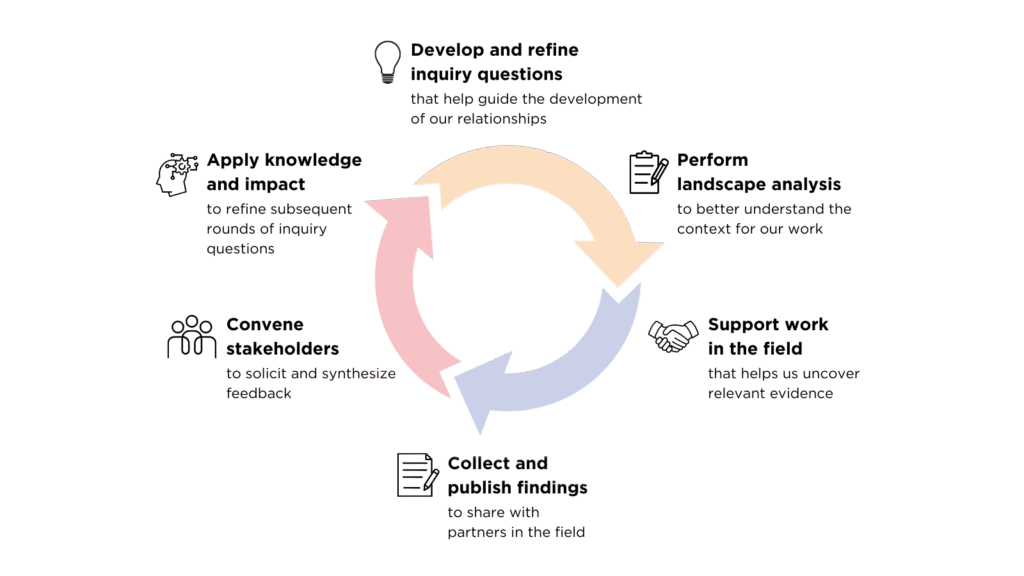
We know that philanthropy doesn’t hold all the answers to addressing tough societal challenges. However, we believe that philanthropy is uniquely positioned to ask big questions of our society, and to bring together the right stakeholders to answer those questions. Our inquiry-driven approach to grantmaking is an iterative process of asking questions, systematically interrogating them, and applying our learnings to subsequent rounds of questioning.

Our approach is grounded in the scientific method, and is inspired by our chairman and founder David Siegel’s approach to his life’s work. We ask questions that help us develop an informed hypothesis, support academic and field-work that uncovers evidence, track and interpret outcomes thoughtfully, and apply our findings in order to inform the next phase of inquiry.
Knowledge and Impact

This approach moves beyond the traditional grant check-in. We are deliberate about how we gather and interpret information, ensuring that learnings accumulate over time and across grants and portfolios. We call this work Knowledge and Impact. We deeply engage with our partners  to surface insights that advance both Siegel’s inquiry and their own—and to translate those learnings into knowledge that can inform the broader field.

Grantees

Our Grantees

We support a wide range of grantees who are engaged with advancing our understanding of the driving questions that underpin our research. We also support a diverse range of grantee work, from academic research projects, to mission-driven programs, to institutions informing policy and governance across a range of sectors.

See all Grantees

Go Deeper

All Insights
Reflections
You spoke, we listened: 2025 Grantees’ Perspectives on Funder-Grantee Relationships and Siegel Family Endowment

We believe feedback is essential to continuous improvement. Philanthropy operates within inherent power imbalances, making it all the more important…

Read More
News | Reflections
Playback: Siegel’s 2026 “Ask-Me-Anything”

Siegel’s annual Ask Me Anything webinar is an opportunity for our friends and partners to learn about our plans for…

Read More
Big Ideas | Reflections
Rural Consultation Series: Rural Innovation Is Happening. Why Don’t We Hear More About It?

In our work—with grantees, through firsthand observation, and in the stories we intentionally seek—we’ve witnessed the power of technological innovation…

Read More